
Education becomes more engaging when students have opportunities to explore ideas, express themselves, and connect classroom learning with real-life experiences. While traditional teaching methods remain important, creative activities can help students understand difficult concepts, develop communication skills, and participate more actively in lessons.
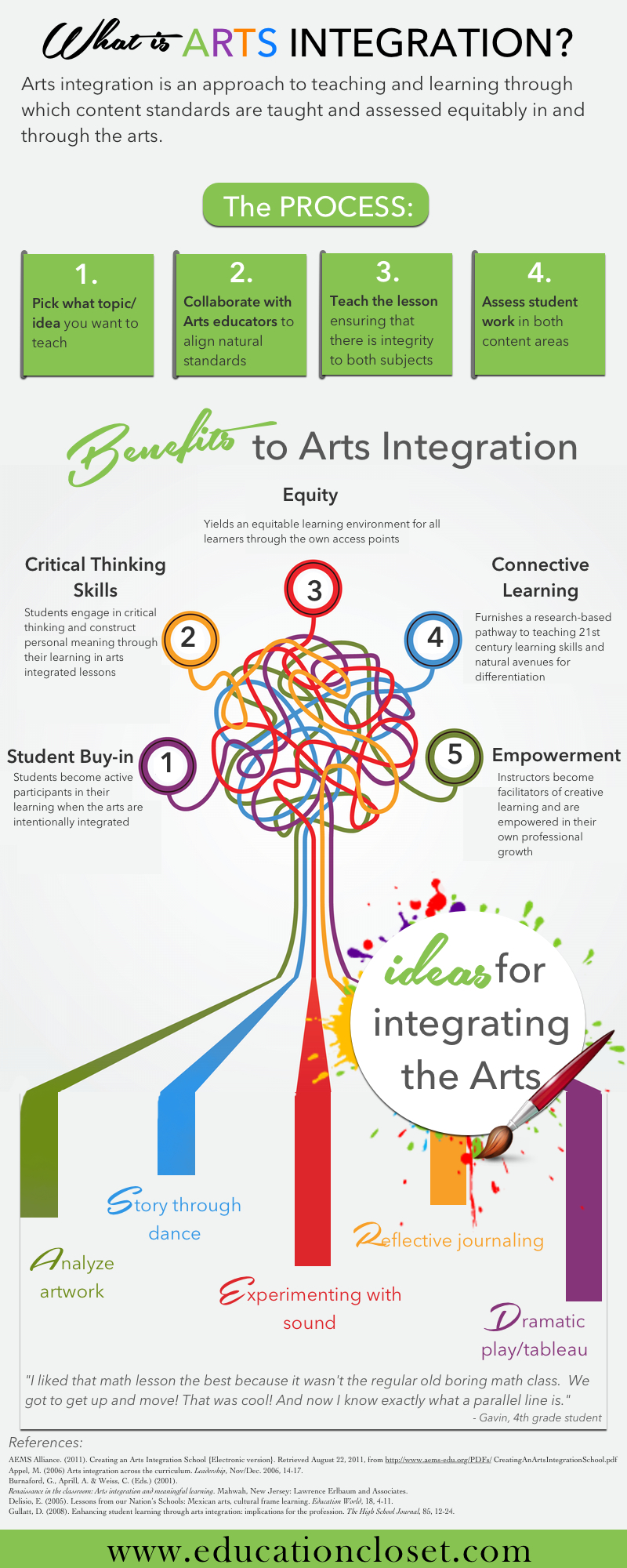
Arts integration in education combines creative disciplines such as visual arts, music, drama, dance, and storytelling with academic subjects. Instead of teaching art as an entirely separate activity, teachers use artistic processes to help students understand concepts in mathematics, science, language arts, history, and other areas of the curriculum.
For example, students might create a drawing to explain a scientific process, perform a short scene based on a historical event, or use rhythm to understand mathematical patterns. These activities allow learners to explore the same concept through different approaches while developing their creativity and problem-solving abilities.
The good news is that teachers do not need expensive equipment, specialized art studios, or additional class periods to get started. With thoughtful planning, creative arts integration can become a practical part of everyday classroom instruction.
In this guide, we explore the benefits of arts integration, effective teaching strategies, subject-specific activities, and practical ways educators can incorporate creativity into daily lessons.
What Is Arts Integration in Education?
Arts integration in education is a teaching approach that connects artistic practices with learning objectives from other academic subjects. Students learn through the arts while also developing knowledge and skills in the subject being taught.
For example, a teacher introducing a lesson about the solar system might ask students to create a visual model of the planets. Students could use different sizes, colors, and labels to represent the planets while discussing their order, characteristics, and relative positions.
Similarly, a language arts teacher might invite students to perform a scene from a story. Through acting, dialogue, and movement, students explore character development, emotions, plot, and themes.
Effective arts integration involves more than adding a coloring activity to an ordinary lesson. The creative activity should have a clear educational purpose and help students understand or demonstrate the subject matter.
Arts integration can include several disciplines:
- Visual arts: Drawing, painting, collage, sculpture, and illustration.
- Music: Rhythm, singing, composition, and sound exploration.
- Drama: Role-playing, improvisation, storytelling, and performance.
- Dance and movement: Using physical movement to represent ideas, patterns, and processes.
- Creative writing: Poetry, scripts, imaginative storytelling, and other forms of artistic expression.
Teachers can select the approach that best fits their learning objectives, students’ interests, available resources, and classroom environment.
Why Is Arts Integration Important in Education?
Arts-integrated learning creates opportunities for students to engage with academic concepts in different ways. It can make lessons more interactive while giving students additional opportunities to practise communication, interpretation, and creative thinking.
1. Encourages Active Student Participation
Students often become more involved when lessons include opportunities to create, discuss, perform, or experiment.
Instead of listening to an explanation alone, students can demonstrate their understanding through a drawing, model, performance, or collaborative project.
For example, students studying the water cycle could create a sequence of illustrations showing evaporation, condensation, precipitation, and collection. Explaining each stage in their own words helps connect the creative task to the scientific concept.
Teachers should ensure that every activity has a meaningful learning goal rather than using creativity simply to keep students entertained.
2. Makes Complex Concepts Easier to Understand
Some academic concepts are difficult to understand through verbal explanations alone. Artistic representations can help students visualize relationships, processes, and abstract ideas.
In mathematics, students might use shapes and patterns to explore geometry. In science, they could create diagrams or physical models of ecosystems. In history, students might construct a timeline illustrated with significant events.
These activities provide alternative ways to represent information and can reveal misunderstandings that might not become obvious during a conventional lesson.
Arts-based activities should complement clear instruction, discussion, and practice rather than replace them.
3. Develops Creativity and Problem-Solving Skills
Creative tasks often require students to make decisions, test ideas, overcome challenges, and revise their work.
For example, students designing a model bridge might need to decide which materials to use, how to distribute weight, and how to make their structure stable.
This process encourages them to consider different solutions and learn from mistakes.
Teachers can strengthen these skills by asking open-ended questions, encouraging experimentation, and giving students opportunities to explain why they made particular choices.
4. Supports Communication and Collaboration
Group performances, murals, musical activities, and creative projects provide opportunities for students to share ideas and work toward common goals.
Students learn to listen to classmates, explain their reasoning, divide responsibilities, and resolve disagreements.
A group creating a short dramatic performance about a historical event, for example, must discuss the event, select important details, develop dialogue, and coordinate their roles.
Teachers can support effective collaboration by assigning clear responsibilities and ensuring that every student has a meaningful opportunity to contribute.
5. Provides Different Ways to Demonstrate Learning
Students do not all express their understanding in the same way. Some communicate effectively through writing, while others may demonstrate their knowledge more clearly through diagrams, movement, music, or spoken presentations.
Arts integration offers additional ways for students to communicate what they know.
For example, after reading a story, students could write a summary, illustrate an important scene, or perform a short dialogue between two characters.
The academic learning objective should remain clear, and teachers should assess whether students understand the subject matter rather than judging artistic talent alone.
6. Creates Opportunities for Student Expression
Creative activities allow students to communicate ideas, interpretations, and perspectives.
When studying literature or social studies, students may create artwork that represents a character’s experiences or a community’s traditions. Discussing their creative choices can help teachers understand how students interpret the material.
Teachers should provide respectful opportunities for students to share their work without requiring anyone to disclose personal experiences or feelings they would prefer to keep private.
10 Creative Arts Integration Strategies for Everyday Lessons
Teachers can integrate the arts into everyday instruction through small, manageable activities. The following strategies can be adapted for primary, middle, and secondary classrooms.
1. Use Drawing to Explain Academic Concepts
Drawing is a simple and accessible way to connect creativity with academic learning.
Ask students to illustrate a process, concept, character, or relationship they are studying.
Examples include:
- Drawing the stages of a plant’s life cycle in science.
- Illustrating fractions using circles and rectangles in mathematics.
- Creating a visual timeline of important historical events.
- Drawing a character’s actions and motivations after reading a story.
- Designing a labeled diagram of a natural habitat.
After completing their drawings, students should explain what each part represents. This discussion helps teachers determine whether the activity supports genuine understanding.
Artistic ability should not be the primary assessment criterion. The focus should be on the accuracy of the concepts and the student’s explanation.
2. Incorporate Music and Rhythm Into Lessons
Music can help students explore patterns, sequences, language, and movement.
Teachers can use clapping, simple percussion, songs, or student-created rhythms to reinforce academic concepts.
For example, students learning multiplication patterns could clap or tap a rhythm while counting in multiples. Language teachers might use rhythm to practise syllables, pronunciation, or poetry.
In science, students could create a short song that explains the stages of a process, provided the lyrics accurately represent the subject matter.
These activities work particularly well when they are brief, purposeful, and connected directly to the lesson objective.
Teachers should also offer non-musical alternatives for students who prefer not to sing or who find sound-based activities distracting.
3. Use Drama and Role-Playing to Explore Ideas
Drama gives students opportunities to examine ideas by taking on roles, making decisions, and considering different perspectives.
In a history lesson, students might act out a carefully researched scene from a historical period. During a language arts lesson, they could perform a conversation between two characters and explain how their dialogue reveals personality or conflict.
Drama can also support learning in science and social studies.
For example, students might role-play a town meeting about environmental conservation, with different groups representing residents, scientists, and local officials.
To make the activity effective:
- Explain the academic concept or scenario.
- Provide relevant information and clear role descriptions.
- Give students time to prepare.
- Let them perform or present their ideas.
- Discuss the subject matter and what they learned.
Teachers should distinguish historical evidence from imaginative interpretation and help students understand when a performance includes fictional details.
4. Connect Mathematics With Visual Arts
Mathematics and visual arts share many concepts, including symmetry, proportion, measurement, geometry, and patterns.
A geometry lesson, for instance, could involve creating artwork using triangles, circles, rectangles, and other shapes.
Students might design a repeating pattern, explore symmetry through paper folding, or create a mosaic while calculating the area of different sections.
A practical classroom activity could involve designing a geometric tile pattern.
Students would:
- Select geometric shapes.
- Identify angles and sides.
- Create a repeating arrangement.
- Measure selected sections.
- Explain the mathematical rules behind their design.
This strategy allows students to apply mathematical knowledge while producing a visual representation of their understanding.
5. Integrate Storytelling Into Science Lessons
Storytelling can help students organize information and explain scientific processes in a meaningful sequence.
For example, students studying the water cycle could write a short story from the perspective of a water droplet. The story might describe evaporation, condensation, precipitation, and the movement of water through the environment.
Similarly, students studying ecosystems could create a story that follows the movement of energy through a food chain.
The creative element encourages imagination, but scientific accuracy remains essential.
Ask students to identify the facts included in their stories and explain how each event relates to the scientific concept.
This approach combines creative writing, subject knowledge, sequencing, and communication.
6. Use Movement to Teach Patterns and Processes
Movement can help students explore concepts involving order, space, direction, and relationships.
In mathematics, students might use body movements to represent repeating patterns or geometric transformations.
In science, small groups could demonstrate how particles move differently in solids, liquids, and gases, followed by a discussion of the limitations of the model.
Language teachers could use movement to practise action verbs or sequence the events of a story.
For younger learners, short movement-based activities can provide a change of pace while reinforcing the lesson.
Teachers should ensure there is enough space for safe movement and provide seated or alternative participation options for students who need them.
7. Create Collaborative Classroom Murals
A classroom mural allows students to contribute individual ideas to a shared visual project.
For example, a class studying biodiversity might create a mural showing different habitats and the organisms that live in them.
Each group could research one habitat, draw relevant plants and animals, and write short explanations of how those organisms interact with their environment.
The finished mural becomes a visual learning resource that can be revisited during later lessons.
To make collaborative artwork educationally meaningful, teachers should establish clear academic requirements, divide responsibilities fairly, and ask students to explain their contributions.
A mural can also be created with recycled paper, magazines, markers, and other low-cost materials.
8. Use Poetry to Strengthen Language Learning
Poetry provides opportunities to explore vocabulary, figurative language, rhythm, sound, and concise expression.
Students might write a short poem about a natural process, historical figure, mathematical pattern, or literary character.
For example, a science class studying seasons could write descriptive poems using observations about temperature, daylight, weather, and plant growth.
In language arts, students could rewrite a scene from a story as a poem or use metaphor to describe a character’s emotions.
Teachers can provide sentence starters, word banks, or simple poem structures for students who need support.
Assessment should focus on the learning objective, such as vocabulary use or accurate subject knowledge, rather than requiring every student to produce highly polished poetry.
9. Introduce Student-Created Models and Sculptures
Models and sculptures can help students represent objects, structures, and relationships that are difficult to observe directly.
In science, students might construct a model of a cell, an ecosystem, or a geological formation. In mathematics, they could build three-dimensional shapes and compare their properties.
Teachers can encourage students to use cardboard, paper, clay, recycled packaging, or other accessible materials.
A successful activity should include more than construction. Students should label important components, explain how their model represents the real subject, and identify any limitations.
For example, a model of the solar system may show the order of the planets but cannot accurately represent both their relative sizes and their enormous distances using a single convenient scale.
Discussing these limitations helps students develop scientific reasoning alongside creative skills.
10. End Lessons With Creative Reflection
Short creative reflections can help students review what they learned and identify questions that remain unanswered.
At the end of a lesson, ask students to choose one activity:
- Draw the most important concept from the lesson.
- Write a four-line poem summarizing the main idea.
- Create a small comic strip explaining a process.
- Use three symbols to represent what they learned.
- Act out a concept for a partner.
- Design a simple visual diagram and explain it.
This approach gives teachers a quick way to assess understanding while allowing students to choose an appropriate form of expression.
Creative reflection can be especially useful when a lesson includes several connected ideas that students need to summarize.
Arts Integration Examples Across Different School Subjects
Arts integration works best when the creative activity supports the learning goals of the subject being taught.
The following examples show how teachers can connect artistic approaches with everyday lessons.
| Subject | Creative activity | Learning objective |
|---|---|---|
| Mathematics | Create geometric patterns or mosaics | Explore shapes, symmetry, fractions, and measurement |
| Science | Illustrate a life cycle or build a model | Explain scientific processes and relationships |
| English and language arts | Perform a scene or write a poem | Develop comprehension, vocabulary, and communication |
| History | Create a historical timeline or dramatic scene | Understand chronology, evidence, and historical perspectives |
| Geography | Produce a map-based collage | Identify places, physical features, and human-environment relationships |
| Environmental studies | Create recycled-material artwork | Explore sustainability and responsible resource use |
| Foreign languages | Perform a short dialogue | Practise vocabulary, pronunciation, and conversational skills |
| Social studies | Role-play a community decision | Explore civic participation, viewpoints, and cooperation |
These activities can be adjusted for different age groups and levels of subject knowledge.
For younger students, teachers may provide templates, examples, and guided instructions. Older students can take greater responsibility for research, creative decisions, and presentations.
How to Plan an Effective Arts-Integrated Lesson
Creative activities are most valuable when they are planned around clear learning objectives. A simple planning process can help teachers integrate the arts without making lessons unnecessarily complicated.
Step 1: Start With the Learning Objective
Decide what students should know or be able to do by the end of the lesson.
For example, students might need to explain the water cycle, identify geometric properties, or analyze the motivation of a literary character.
The learning objective should guide every other decision.
Step 2: Select a Suitable Art Form
Choose the creative discipline that best supports the objective.
Drawing may be useful for explaining a process, drama for exploring perspectives, and music for investigating patterns or rhythm.
Consider students’ ages, interests, available time, classroom space, and learning needs.
Step 3: Design the Creative Activity
Give students a clear task with appropriate instructions and boundaries.
For example, if the objective is to understand the water cycle, students might create a labeled illustration or short performance showing its main stages.
Explain what the finished work must demonstrate, while allowing reasonable creative choices.
Step 4: Connect Creativity With Academic Content
Include opportunities for students to explain, discuss, or justify their creative decisions.
Ask questions such as:
- What does this part of your artwork represent?
- Which facts did you use to develop your performance?
- How does your design demonstrate the mathematical concept?
- What evidence supports your interpretation?
These questions help students connect artistic decisions with subject knowledge.
Step 5: Assess Learning
Evaluate students according to the intended learning objectives.
A simple rubric might assess subject accuracy, explanation, application of concepts, and participation in the learning process.
Do not confuse artistic polish with academic understanding. A student may create a simple drawing that demonstrates excellent scientific knowledge, while an elaborate illustration may contain conceptual errors.
Step 6: Reflect and Improve
After the lesson, consider whether students met the objectives and which parts of the activity were most useful.
Ask students what helped them understand the concept and what they found challenging.
Use this feedback to adjust future activities, instructions, materials, and assessment methods.
How to Integrate Arts Into Lessons With Limited Resources
Schools do not need dedicated art rooms or large budgets to use creative teaching strategies.
Many arts-integrated activities can be completed using materials that are already available.
Use everyday classroom materials
Paper, pencils, cardboard, magazines, reusable packaging, and basic stationery can support drawing, collage, model-making, and creative writing.
Keep activities short
A five-minute visual summary or short role-play can reinforce an existing lesson without requiring an entire class period.
Reuse materials
Collect clean, safe recyclable materials for suitable projects. Establish clear guidelines for storage, hygiene, and classroom safety.
Use free or existing digital tools
Where devices are available, students may create digital illustrations, simple presentations, audio recordings, or short animations using tools already provided by the school.
Digital activities should have clear learning goals and should not create unnecessary barriers for students without reliable device access.
Encourage student choice
Offer several ways to demonstrate the same concept. Students might choose between a drawing, a short written explanation, or a simple performance.
This can reduce the need for specialized supplies while giving students meaningful opportunities to participate.
Common Challenges in Arts Integration and How to Address Them
Although arts integration offers valuable learning opportunities, teachers may encounter challenges when introducing creative activities.
Limited classroom time
Creative tasks can become time-consuming when students are given too many materials or unclear instructions.
Solution: Start with small activities, prepare materials in advance, and connect the task directly to the lesson objective.
Different levels of artistic confidence
Some students may hesitate to participate because they believe they are not good at drawing, singing, acting, or performing.
Solution: Emphasize experimentation and understanding rather than artistic talent. Offer multiple ways to participate and avoid grading students primarily on artistic skill.
Difficulty assessing creative work
Teachers may find it challenging to evaluate projects that have different formats or styles.
Solution: Use a consistent rubric based on academic understanding, accuracy, explanation, and application of the target concepts.
Classroom management concerns
Movement, group work, and performance can create noise or make transitions more difficult.
Solution: Establish clear instructions, set time limits, assign responsibilities, and teach students how to transition between activities.
Curriculum coverage pressures
Teachers may worry that arts-integrated lessons take time away from required content.
Solution: Choose activities that directly reinforce curriculum objectives rather than adding unrelated creative tasks. Begin with one lesson or learning objective at a time.
How to Assess Student Learning During Arts Integration
Assessment helps teachers determine whether creative activities are improving students’ understanding of academic content.
A balanced assessment approach may include several methods.
Observation: Watch how students apply concepts while creating, performing, or collaborating.
Student explanations: Ask students to describe their work and explain the academic ideas behind their choices.
Short written reflections: Invite students to summarize what they learned and identify questions they still have.
Project rubrics: Assess subject accuracy, application of concepts, communication, and relevant learning goals.
Peer discussion: Let students explain their interpretations and respond constructively to classmates.
Follow-up questions: Use a short quiz, problem, or discussion to check whether students can apply the concept beyond the creative activity.
For example, after students create geometric artwork, ask them to identify the shapes they used, calculate selected measurements, or explain the pattern rule.
This helps establish whether the artistic task supported transferable learning rather than simply producing an attractive final product.
Frequently Asked Questions
1. What is arts integration in education?
Arts integration in education is an instructional approach that combines artistic disciplines with academic subjects. Students use visual arts, music, drama, movement, or creative writing to explore concepts and demonstrate their understanding of subjects such as mathematics, science, language arts, and history.
2. What are some examples of arts integration in the classroom?
Examples include drawing scientific diagrams, creating geometric patterns, performing historical scenes, writing poems about academic topics, building models, and using rhythm to explore mathematical sequences. The activity should directly support the lesson’s learning objective.
3. What are the benefits of arts integration?
Arts integration can create additional opportunities for student engagement, creative thinking, communication, collaboration, and conceptual understanding. Its effectiveness depends on the quality of instruction, the alignment between the activity and the learning objective, and the needs of the students.
4. How can teachers integrate arts into everyday lessons?
Teachers can begin by selecting a clear learning objective and choosing a suitable creative activity. They can incorporate short drawing tasks, storytelling, movement, role-play, music, or creative reflection into existing lessons without redesigning the entire curriculum.
5. Does arts integration improve academic performance?
Research suggests that some arts-based approaches can support particular learning outcomes, but results vary by activity, subject, and implementation. Teachers should use evidence-informed methods, maintain clear academic objectives, and assess whether students are learning the intended content.
6. Is arts integration suitable for all grade levels?
Yes. Activities can be adapted for early childhood, primary school, middle school, and secondary education. Younger students may benefit from guided drawing and movement, while older students can engage in research-based performances, complex models, and independent creative projects.
7. What is the difference between arts integration and teaching art as a separate subject?
Teaching art as a separate subject focuses primarily on developing artistic knowledge and skills. Arts integration connects artistic processes with learning objectives in other subjects. Both approaches can be valuable, and arts integration should complement rather than replace dedicated arts education.
8. How can teachers assess arts-integrated projects fairly?
Teachers should assess the academic objective using clear criteria, such as conceptual accuracy, explanation, application, and evidence of understanding. Artistic skill should only be assessed when it is itself an intended learning objective.
Conclusion
Creative arts integration provides teachers with practical ways to make everyday lessons more interactive, meaningful, and accessible. By combining visual arts, music, drama, movement, and storytelling with academic subjects, educators can give students additional opportunities to explore ideas, communicate their understanding, and solve problems.
Successful arts integration begins with a clear learning objective. Teachers should select creative activities that reinforce academic concepts, provide appropriate materials and instructions, and assess student understanding rather than focusing only on the finished artwork.
Even small activities can make a difference. A drawing that explains a scientific process, a short performance that explores a historical event, or a rhythmic exercise that reinforces mathematical patterns can connect creativity with meaningful learning.
Start with one lesson this week and choose a creative activity that directly supports its objective. As teachers observe student responses and refine their approach, arts integration can become a sustainable part of everyday instruction and help create a richer learning experience for the entire classroom.
